
Table of Contents
- The Litmus Test: Inversion of Control
- Code Example: The Difference in Action
- Heuristics: When to Use Which
- The "Grey Area" (React vs. Next.js)
- Conclusion
In my years of interviewing candidates and auditing codebases, I’ve noticed a recurring confusion. Developers often use the terms "library" and "framework" interchangeably, or worse, they choose one over the other based on hype rather than architectural fit.
This isn't just semantics. Confusing a library for a framework (or vice versa) is often the root cause of "spaghetti code" in large applications. If you treat a library like a framework, you end up with a lack of structure. If you treat a framework like a library, you fight against the tool at every turn.
Here is how I distinguish them, and the heuristic I use to decide which one to reach for.
The Litmus Test: Inversion of Control
The distinction isn't about size, popularity, or complexity. It comes down to a single principle: Inversion of Control (IoC).
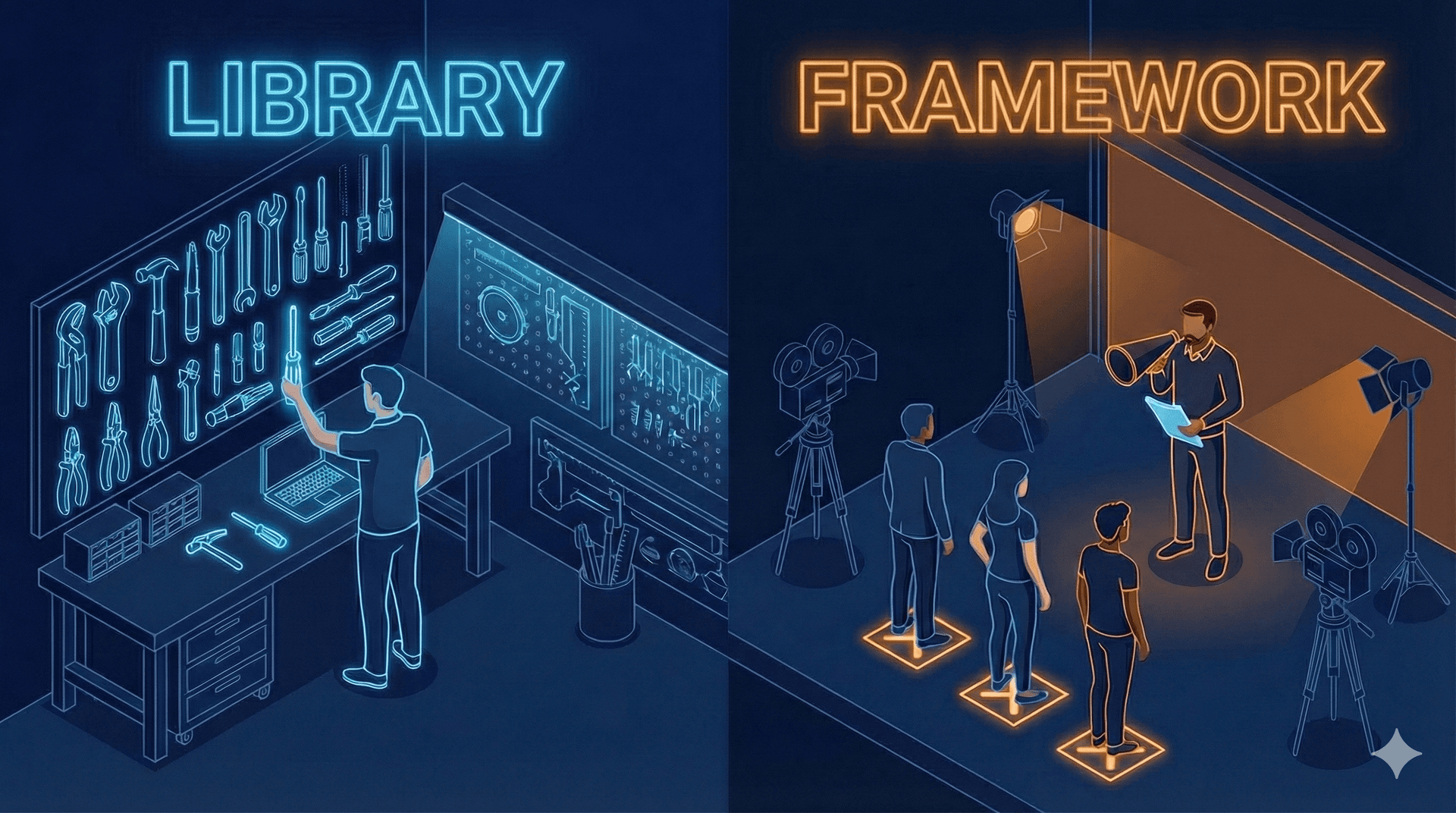
- Library: You call the code. You are in control.
- Framework: The code calls you. The framework is in control.
Martin Fowler, a definitive voice in software architecture, puts it best:

Inversion of Control is a key part of what makes a framework different from a library. A library is essentially a set of functions that you can call, these days usually organized into classes. Each call does some work and returns control to the client. With a framework, the control is inverted: the framework calls you.
— Martin FowlerThe "Hollywood Principle"
I often explain this to junior engineers as the Hollywood Principle: Don't call us, we'll call you.
When you use a library (like lodash or React in its purest form), you are the director. You decide when to render a component, when to map over an array, and when to make a network request.
When you use a framework (like Angular, NestJS, or Django), the framework is the director. It provides the stage, the script, and the lighting. You just step onto your designated mark (e.g., a ngOnInit lifecycle hook or a Controller class) and say your lines.
Code Example: The Difference in Action
Let's look at a simple HTTP server example to visualize this trade-off.
1. The Library Approach (Express.js)
Technically, Express is often called a "micro-framework," but it behaves very much like a library because you define the architecture. You dictate the flow.
import express from 'express';
const app = express();

// I am explicitly telling the app exactly what to do and where to listen.
// I control the entry point.
app.get('/health', (req, res) => {
  res.json({ status: 'ok' });
});

// I decide when to start the server.
app.listen(3000, () => {
  console.log('Server running on port 3000');
});
2. The Framework Approach (NestJS)
NestJS (which runs on top of Express/Fastify) forces you into its structure. You don't write the main loop; you write classes that the framework discovers and instantiates.
import { Controller, Get } from '@nestjs/common';

// I am adding metadata (Decorators).
// The Framework will scan this, instantiate it, and route traffic to it.
@Controller('health')
export class HealthController {

  // I don't call this method. The Framework calls it when a request matches.
  @Get()
  check() {
    return { status: 'ok' };
  }
}
In the NestJS example, I never explicitly tell the app how to route the request or when to execute the class. I just follow the rules, and the framework handles the execution flow.
Heuristics: When to Use Which
The choice usually trades flexibility for velocity.
Choose a Library when:
- You need granular control: You are building a highly custom solution where standard patterns (like MVC) don't fit.
- You are solving a specific problem: You need to parse dates (
date-fns) or visualize data (D3.js). You don't need a whole ecosystem; you just need a tool. - You have a small, experienced team: Senior engineers often prefer libraries (like React + distinct separate tools) because they can architect a bespoke solution perfectly tailored to the business domain.
Choose a Framework when:
- You need consistency at scale: If you have 20 developers working on the same app, you don't want 20 different opinions on how to structure a folder or handle an HTTP request. Frameworks enforce a "standard way."
- Velocity is paramount: You don't want to waste two weeks debating which router or state management library to use. Frameworks come "batteries included".
- You are handing off the project: If I build a project in
AngularorNext.js, any other developer who knows that framework can jump in and understand the structure immediately. If I build a custom stack using 15 disparate libraries, the onboarding cost is massive.
The "Grey Area" (React vs. Next.js)
The most common point of confusion today is React. Is it a library or a framework?
React itself is a library. It handles one thing: rendering views based on state. It doesn't care about routing, HTTP, or folders.
However, most modern production React is written within Next.js, which is absolutely a framework. Next.js dictates your file structure (App Router), your data fetching strategies (Server Components), and your routing.
Conclusion
Don't let the hype cycle dictate your tools. If you are building a small, focused tool, a framework might be overkill bloat. If you are building a jagged, enterprise-grade platform, stitching together 50 libraries is a recipe for maintenance hell.
- Libraries give you freedom, but freedom requires vigilance.
- Frameworks give you structure, but structure requires compliance.
Choose the one that fits your team's discipline level and the project's long-term scale.