Teamwork in Software Engineering: More Than Just "Working Together"
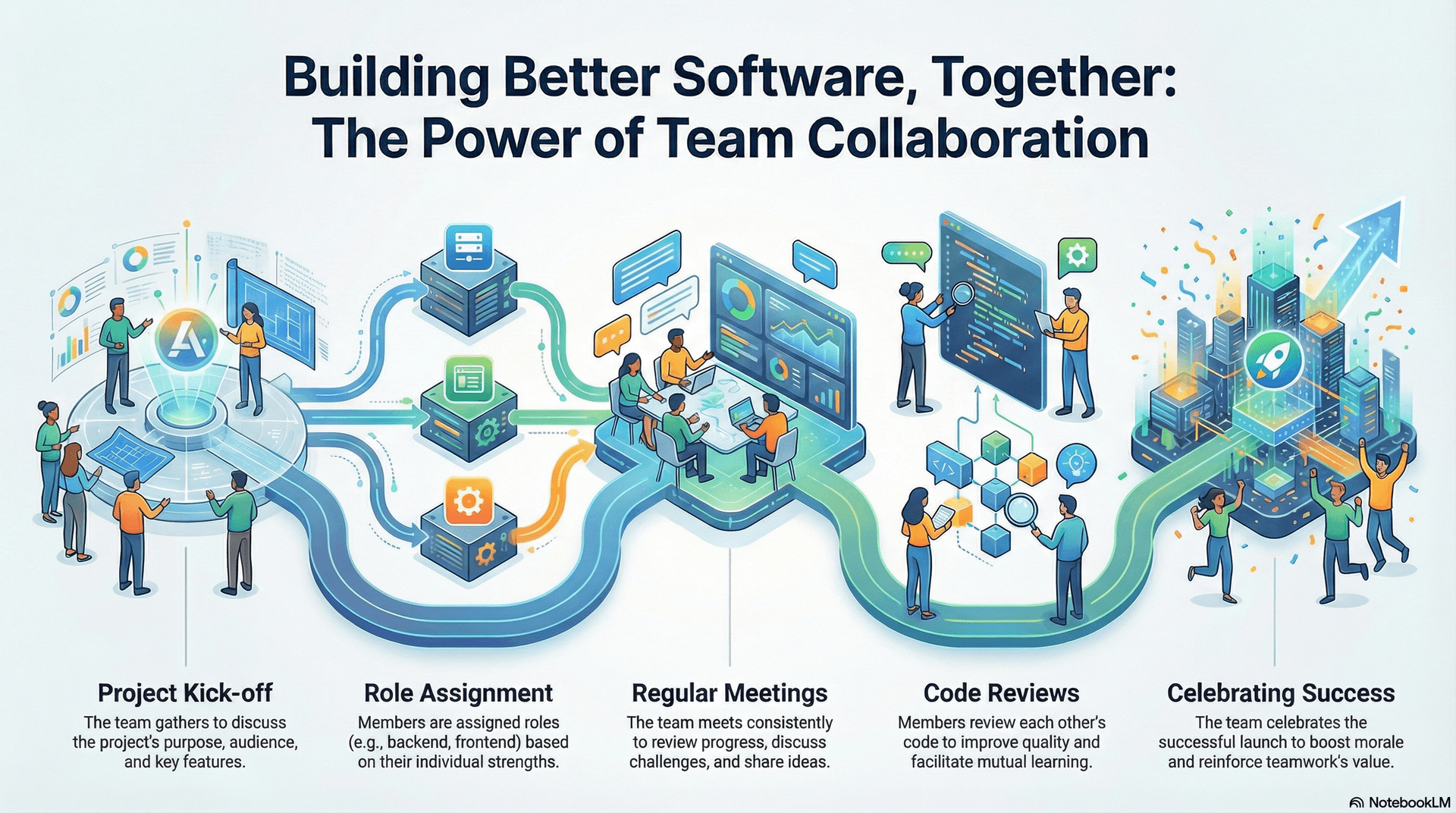
Teamwork is not just a buzzword in software engineering; it is a core part of how real projects get delivered. Modern software systems are too complex for a single person to design, build, test, deploy, and maintain alone. That is why collaboration is not optional—it is the default way of working.
Why Teams Matter: From Sports to Software
Imagine a sports team. Each player has a different role: goalkeeper, defender, midfielder, striker. If everyone tried to play the same position, the team would fail. Success depends on coordination, trust, and making use of each player's strengths.
Software teams work the same way. One developer may be excellent at backend APIs, another at frontend interfaces, another at testing or infrastructure. When these skills are combined and aligned toward a shared goal, the team can solve problems that would be impossible for individuals working in isolation.
Another useful analogy is a cooking team preparing a big meal. One person chops vegetables, another cooks the main dish, another prepares dessert. If each person tried to cook the entire menu alone, it would take longer and the quality would probably be worse. By dividing responsibility and collaborating, the team delivers a better result, faster.
In software engineering, teamwork has the same effect: it increases speed, quality, and learning.
A Concrete Example: Building a Mobile Application as a Team
Consider a team that needs to build a new mobile app. The project typically goes through several stages where teamwork is essential.
1. Project Kick-off: Aligning on the Goal
The team starts with a kick-off meeting. In that meeting, they discuss:
- What problem the app is solving
- Who the target users are
- Which features are most important
This initial discussion is not just a formality. It creates a shared understanding. When everyone hears the same context and asks questions, the team reduces the risk of building the wrong thing. Good teamwork at this stage means listening carefully, asking clarifying questions, and making sure everyone understands the goal in the same way.
2. Role Assignment: Using Each Person's Strengths
Once the goal is clear, the work is divided according to skills and interests. For example:
- One engineer focuses on backend development (APIs, databases, authentication).
- Another focuses on frontend or mobile UI (screens, navigation, user interactions).
- Another may specialize in testing and quality assurance, defining test cases and automation.
- A designer may own visual design and user experience, ensuring the app is usable and attractive.
- A product owner or project manager coordinates priorities and communication with stakeholders.
Role assignment is not about creating rigid silos. Instead, it is about making sure that the most important tasks are handled by the people best suited to them, while still allowing collaboration and knowledge sharing.
3. Collaboration During Implementation
During development, teamwork shows up in many practical ways:
- Code reviews: Engineers review each other's code to find defects early and share knowledge.
- Pair programming: Two developers work together on the same task, combining their experience to solve problems more efficiently.
- Regular check-ins (stand-ups): The team synchronizes on progress, blockers, and next steps.
- Shared documentation: Decisions about architecture, APIs, and standards are documented so everyone can follow the same guidelines.
Good collaboration here avoids duplicated effort, inconsistent implementations, and misunderstandings.
4. Testing and Integration as a Team Effort
When the main features are ready, testers, developers, and sometimes designers work together to validate the app:
- Testers report bugs with clear steps to reproduce.
- Developers fix issues and improve the implementation.
- Designers verify that the user experience matches the intended design.
- The team might run usability tests with real or representative users and then adjust the app based on feedback.
This phase shows that quality is not the responsibility of a single role. It is a shared responsibility across the team.
Benefits of Teamwork in Software Engineering
Effective teamwork provides several concrete benefits:
1. Better Problem Solving
Different people bring different perspectives. One engineer might see a performance optimization; another might identify a usability issue; another might propose a simpler architecture. When these viewpoints are discussed openly, the final solution is usually stronger.
2. Faster Delivery (When Organized Well)
By dividing tasks and working in parallel, teams can deliver features faster than a single person. However, this only works if communication is good and responsibilities are clear. Otherwise, time is lost resolving conflicts, redoing work, or fixing misunderstandings.
3. Knowledge Sharing and Growth
Junior and senior engineers working together create natural learning opportunities. Code reviews, pair programming, and technical discussions help everyone grow. Over time, the team becomes more resilient because knowledge is not concentrated in a single person.
4. Higher Quality and Fewer Defects
When multiple people review requirements, designs, and code, more potential issues are identified early. The result is a more stable and reliable product.
Common Challenges in Teamwork (And How to Mitigate Them)
Teamwork is not automatically positive. There are real challenges that can damage collaboration if they are not managed.
1. Miscommunication
If goals, requirements, or decisions are not communicated clearly, different team members may move in different directions. To reduce this, teams should maintain:
- Clear written requirements
- Shared documentation
- Regular, focused meetings
2. Unclear Responsibilities
When it is not clear who owns which part of the system, tasks can be duplicated or completely missed. Simple tools like RACI matrices or clear role definitions in planning sessions can help.
3. Conflict and Ego
Disagreements are normal, especially on technical topics. The problem is not the conflict itself, but how it is handled. Healthy teams:
- Focus on the problem, not the person.
- Use data, tests, and prototypes to evaluate options.
- Are willing to change their mind when presented with better arguments.
4. Dependence on "Heroes"
Sometimes one person becomes the "only one" who understands a critical part of the system. This is a risk. Strong teams actively share knowledge, document key decisions, and avoid building systems that only one person can maintain.
Strong teams actively share knowledge, document key decisions, and avoid building systems that only one person can maintain.
What Makes Teamwork Effective in Software Projects?
To make teamwork truly effective in software engineering, a few principles help:
- Shared purpose: Everyone must understand why the project exists and who it serves.
- Clear roles but flexible collaboration: People know what they are mainly responsible for, but they also help others when needed.
- Open communication: Team members feel safe asking questions, raising concerns, and suggesting improvements.
- Continuous improvement: The team regularly reflects on what is working and what is not, then adjusts its process.
Conclusion
Teamwork in software engineering is much more than several people writing code in the same repository. It is a structured way of combining different skills, perspectives, and responsibilities to achieve a shared goal. Just like a sports team or a professional kitchen, a software team succeeds when each member understands their role, communicates clearly, and works together toward a common outcome.
Good teamwork does not eliminate all problems, but it gives the team the tools to face complexity, learn faster, and deliver better software than any individual could produce alone.